

As Australia struggles to meet its 2030 targets for viral hepatitis elimination, it is instructive to look at successes elsewhere in the world.
Four Nations Seeking Elimination
As an example, the UK is preparing to apply to the World Health Organization (WHO) for validation of ‘On the path to elimination of hepatitis C’. This application will be submitted as a United Kingdom partnership, with all four nations (England, Scotland, Wales and Northern Ireland) contributing evidence, data and examples of best practice.
“The UK’s progress towards eliminating hepatitis C is remarkable, and we are coordinating the evidence across all four nations to show that the UK as a whole has met the WHO’s programmatic targets – a historic milestone,” explained Dr Monica Desai, a consultant epidemiologist and head of the hepatitis section at the UK Health Security Agency. “But reaching our 2030 goal of eliminating viral hepatitis as a public health threat means breaking all barriers to ensure that people get the testing and treatment they need.
“The final stretch is the hardest. Those we have yet to reach are often the most marginalised, and getting there means connecting people to testing and care while sustaining the harm reduction services that prevent new and repeat infections.
“Yet hepatitis C is only part of the picture. On hepatitis B, around half of those living with the virus remain undiagnosed and very few of those eligible for treatment are in care. Making similar gains will require the same sustained, coordinated effort across all four nations and a renewed commitment to reaching those most affected.”
Part of this gap is being filled by the UK’s growing adoption of opt-out blood testing as a routine part of emergency hospital visits. This means that, unless they specifically choose not to be, patients attending a number of different emergency departments are automatically tested for hepatitis B, hepatitis C, and HIV. The result has been a huge increase in the number of people being tested each year, raising the number of tests by hundreds of thousands.

“We’ve made real progress towards eliminating hepatitis, but with 2030 fast approaching, now is the time to accelerate our efforts,” said Grant Sugden, Chief Executive at Waverley Care, Scotland’s leading charity providing care and support for people living with hepatitis C and HIV. “Ending hepatitis transmission is within our reach, but it will require sustained ambition and action. In Scotland, that means increasing testing in the settings where we know people are being missed, and adapting services so that everyone diagnosed can quickly and easily access the treatment they need.
“Crucially, people with lived experience must be at the heart of how we plan and deliver our response, ensuring services work for the people who need them most. With the right action now, Scotland and the wider UK have an opportunity to lead the way and show that ending hepatitis transmission is not just an ambition, but something we can achieve.”
European Union Halves Viral Hepatitis Deaths
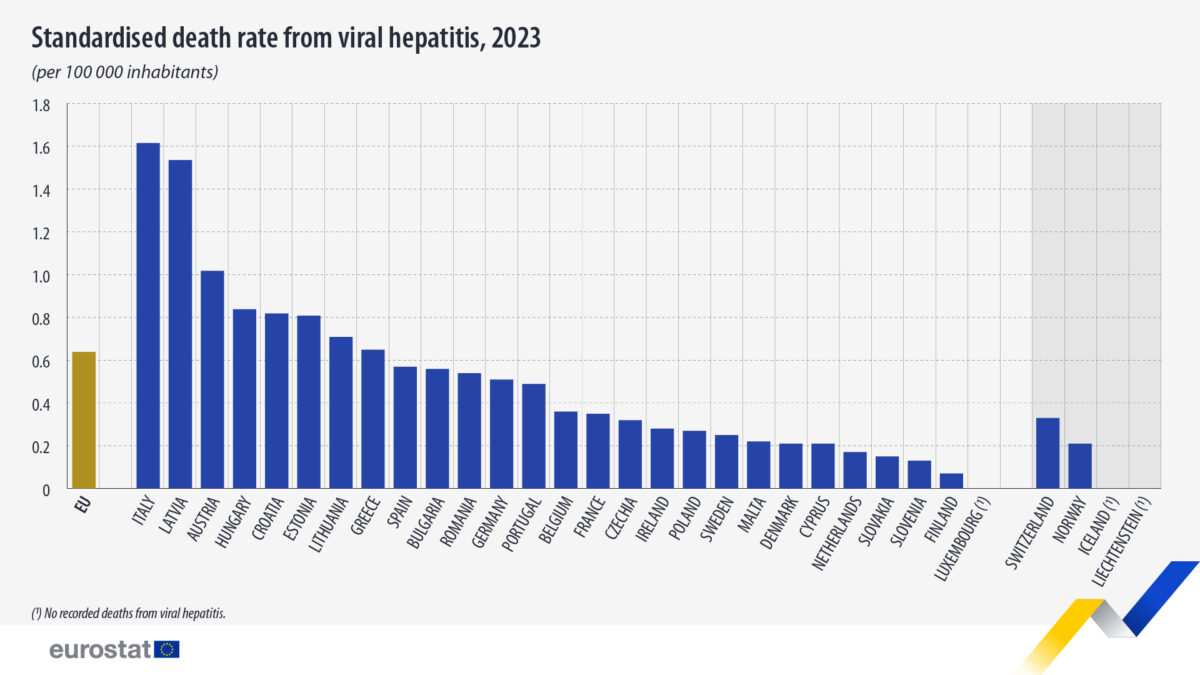
Meanwhile, in the European Union, viral hepatitis deaths have halved in the last decade. In 2023, the last year with full data available from all member countries as yet, there were 3,172 deaths from viral hepatitis, the lowest figure recorded since the data collection started in 2011. This represents a 9.3% decrease compared with 2022 (when there were 3,499 deaths), and a staggering 53.7% drop since 2013 (when there were 6,856 viral hepatitis deaths).
At the EU level, viral hepatitis caused 0.64 deaths per 100 000 people in 2023. The highest standardised death rates were recorded in Italy (1.62 deaths per 100 000 people), Latvia (1.54) and Austria (1.02), while the lowest rates were in Luxembourg (no recorded deaths from hepatitis in 2023), Finland (0.07) and Slovenia (0.13).
China moving beyond the birth dose
According to the Chinese Center for Disease Control and Prevention, an estimated 75 million people in the country are living with chronic hepatitis B, which means one in every three people in the world living with chronic HBV is in China. They have announced that early prevention and community screening with advancing treatment options will remain essential to the nation’s closing the final gaps in viral hepatitis control.
Since incorporating the hepatitis B vaccine into its national immunisation program in 1992 and establishing free newborn vaccination in 2005, the coverage rate for the full three-dose hepatitis B vaccination series among newborns has climbed to 99.6%, while the timely birth-dose rate reached 95.6% compared with the global average of 85%. As a result, the prevalence of hepatitis B surface antigen (HBsAg) among children under five has dropped to 0.3%, while overall prevalence among individuals aged 1 to 69 has fallen to 5.86%, China CDC data shows.

The remaining challenge in this area is adult immunisation. Data from a 2011-2021 study published in the journal Vaccines shows that the average hepatitis B vaccination rate among Chinese adults was only 26.27%, and only 17.09% for people over the age of 40. This is especially concerning as China has one of the world’s fastest ageing populations.
To address these gaps, nine government departments jointly issued a national action plan (2025–2030) for viral hepatitis control. The Action Plan outlines 6 specific targets and 13 key measures across 5 strategic areas: strengthening vaccination, enhancing comprehensive prevention, expanding testing and surveillance, improving treatment services, and strengthening health education and social support.
Key challenges include a large population living with viral hepatitis, a high disease burden from cirrhosis and liver cancer, persistent care cascade gaps, fragmented service delivery, and insufficient dedicated funding. A new focus on increasing investment is critical, including exploring inclusion of viral hepatitis services in the basic public health service package provided to all citizens.
Last updated 16 August 2026
More from:
Enjoyed this article? Subscribe to be notified whenever we publish new stories.
Subscribe for Updates